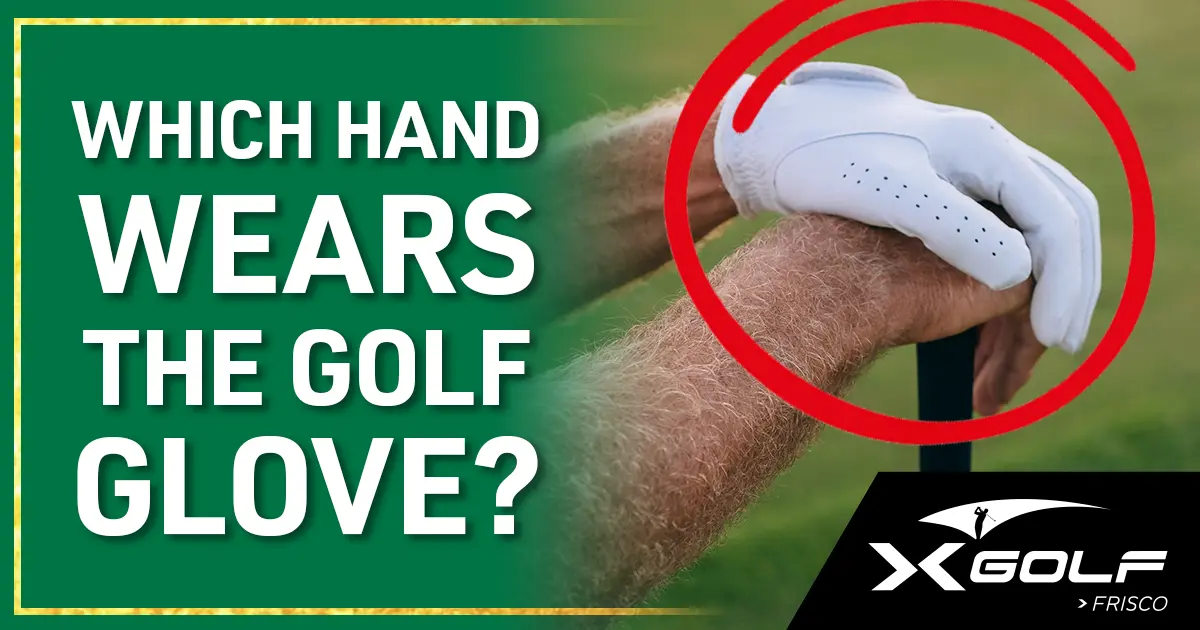
Short answer: your lead hand, the one at the top of the grip. Here is why that hand gets the glove, what flips if you swing left-handed, and how to tell if yours fits.
What hand do you wear a golf glove on?
You wear a golf glove on your lead hand, the hand at the top of the grip. Right-handed golfers wear it on the left hand. Left-handed golfers wear it on the right. The lead hand does most of the holding, so it takes most of the friction.
That is the whole rule. Forget it mid-round and you can work it out in two seconds: whichever hand sits nearest the butt end of the club, the cap on the very end of the handle, is the hand that gets the glove.
Nobody is checking, either. The Rules of Golf do not tell you which hand to glove, or whether to glove one at all. Convention landed on the lead hand because that is where the wear shows up.
Why the lead hand does the heavy lifting
Your two hands have different jobs. The lead hand holds the club and the trail hand supports it.
Grip pressure in the lead hand lives in the last three fingers, the pinky, ring and middle. Hold a club normally, then lift your lead thumb and forefinger off the handle. If the club stays put, your pressure is in the right place.
The trail hand works differently. Most of its pressure runs through the pad of the forefinger, and a trail hand that grabs too hard is what makes players flip the clubface shut right at impact.
Impact adds the real load. Turf, a ball sitting down in rough, a fat strike where the club hits the ground before the ball, all of it sends the club twisting back up the shaft, and your lead hand is the one resisting it. Same patch of skin, same rotation, 60 or 70 times in an hour of bay time.
That is what a glove is for. Tacky leather on the lead hand lets you hold on firmly without squeezing, and squeezing is what kills clubhead speed. Most coaching puts grip pressure at 4 to 6 out of 10, with 10 being as hard as you can hold.
In a Frisco August, there is a second reason. You walk in off the parking lot with damp hands, and the leather is what keeps the handle from moving on you for the first 15 minutes.
Left-handed golfers wear the glove on the right hand
A left-handed golfer wears the glove on the right hand. Set up left-handed and the right hand is the one sitting at the top of the grip, so it does the holding and takes the friction. Everything below applies to you unchanged.
Only 5% to 7% of golfers play left-handed, which is why almost every glove article you land on treats the left hand as the obvious answer.
When you buy, ask for a right-hand glove and check the box before you pay. Plenty of pro shops stock a wall of left-hand gloves and a handful of yours in the back.
One less thing to worry about indoors: the simulators at X-Golf Frisco do not care which way you swing. Set up in a bay, pick your side, and the sensors read your shot the same either way. Same goes for what you turn up in, which we covered in our guide to what to wear to a golf simulator.
Why some golfers wear two gloves
Two gloves is legal, and a handful of very good players do it. Aaron Rai has worn a pair since he was 8 years old and won the 2026 PGA Championship in them. His reason is simple: with one glove on and one hand bare, he cannot feel the grip properly.
Two gloves suit some hands more than others. The golfers who take to it are usually:
- golfers who sweat heavily, which in DFW between June and September is most of us
- anyone whose hands blister on the trail side as well as the lead side
- players in wet weather, where wet-weather gloves are often sold as a pair anyway
- golfers with faster swings, who put more twisting force into the handle for the trail hand to hold against
- older players who find their hands do not close on the grip the way they used to, and who catch themselves squeezing harder to make up for it
The trade-off is feel. Leather over both hands puts a layer between you and the handle, and it shows up most on delicate shots. Rai takes both off to putt and drops to one in the bunker for exactly that reason.
Two gloves also wear at different rates, so you end up replacing a pair to fix one hand.
Why some players go gloveless, and when they glove back up
A small group of very good ball strikers have played bare-handed their whole careers. Fred Couples gave his up as a kid and has not worn one since, because his parents could not keep replacing the gloves he ruined playing every day in Seattle weather. Lucas Glover has never worn one either, and won the 2009 US Open at a soaked Bethpage Black without one.
Going bare-handed means less grip security and more feedback, the sense of exactly where the handle sits in your fingers. Glover’s caddie keeps his grips scrubbed daily so the traction is there without leather, and Rocco Mediate went further and put sandpaper on his.
Full-time gloveless players are rare. The common version is the one you see every week on TV: glove off for putts and short chips, glove back on for anything with a full swing behind it.
Tiger Woods has explained his own version of this. He chips bare-handed because he has more touch and feel that way, then keeps the glove on in the bunker, because he swings so much harder there that the club twists in his hand without it.
It comes down to how hard you are swinging. The glove comes off for small, delicate shots where feel matters, and goes back on for anything you swing hard at.
How a golf glove should fit
Tighter than you would expect. A new glove should feel taut across the palm, because cabretta leather, the thin sheepskin most gloves are cut from, stretches with use, and a glove that already feels comfortable in the shop will be baggy inside a month.
Before you hand over the card, check three things:
- the palm pulls tight with no slack sitting in it
- the fingertips reach the end of each slot with no empty leather bunching past your fingers
- the back of the hand lies flat, with no gap opening up when you close your fist
If you land between two sizes, take the smaller one.
Cadet or standard sizing
Cadet is not a junior size, which catches a lot of people out. A cadet glove has slightly shorter fingers and a slightly wider palm than a standard glove of the same size, built for hands that are broad rather than long.
You probably want cadet if the fingers bunch while the palm still feels tight, if you keep pulling the glove back on every few holes, or if no standard glove has ever fit you right.
When your glove is finished
A worn glove shows it in three places. The fingers go shiny and slick where they hold the club, the palm loosens until the handle starts moving inside the glove rather than with it, and the closure tab quits holding after a few holes.
Wear patterns double as a fit diagnosis. A thumb or heel pad that blows out well before the rest of the glove usually means the proportions are wrong for your hand, which brings you back to the cadet question.
How long does a golf glove last?
Most golf gloves last 6 to 10 rounds before the wear shows, which is what glove maker BRUCE BOLT reports, especially for cabretta models. Play once a week and a single glove can stretch to several weeks or two months, depending on the weather and how you store it.
Two gloves in rotation last longer than the same two worn one after the other. Wear one for the first nine holes and the other for the second nine, let each dry out while the other is on, and sweat never gets long enough to sit in the leather. That is two gloves on the same hand, not one on each.
Lay a wet glove flat to air out, and keep it out of the washing machine, which breaks leather fibers down fast. You will also get through more gloves in a Frisco summer than in a Frisco November, and that is down to the humidity.
Cabretta leather or synthetic?
Cabretta leather gives you the better grip and the better feel. Synthetic holds up longer in hard weather but does not breathe as well, so your hand sits warmer inside it.
If most of your golf happens in July and August in DFW, a synthetic glove will outlast cabretta. If feeling the handle matters more to you, especially around the greens, stay with cabretta and accept that you are buying them more often.
So do you actually need a glove?
Most golfers play better with one. A glove lets you hold on lightly instead of clamping down, which protects your clubhead speed.
It also protects your skin. The lead hand takes the same friction on every swing, and one blister changes how you hold the club for a week.
Wet and humid days are where the gap is widest. Sweat and a DFW August make a bare handle slick, and leather keeps holding when your palm gives up.
Some golfers genuinely do not need one. If your hands are calloused from work, if you play a few mild-weather rounds a year, or if you have tried both and strike it better bare-handed, skip it. And if you are new to the game, our golf tips for beginners will do more for your scores than any glove.
Settle the argument at X-Golf Frisco
The fastest way to find out what your hands actually want is 20 swings with one club, changing nothing else. Ten gloved, ten bare, same lie and same temperature every time, with no wind to push the result around and blame it on.
Two numbers on the X-Golf Frisco screen do the arguing for you. Ball speed shows whether you are losing energy by squeezing, and ball direction, the plus or minus reading for right or left of your target, shows whether the club is turning in your hands.
If your hand position is the thing you want to work on, our guide to gripping a golf club properly is the place to start. And if you want the trash talk that comes with a scorecard, our weekly leagues at Frisco run with standings and cold drinks at the bay.
Bring the group, get food sent to the bay, and let somebody blame their glove. Book your bay at X-Golf Frisco and find out.
Frequently asked questions
Is a “left hand” golf glove meant for a left-handed golfer?
No, and this is the single most common mix-up when buying online. The label names the hand that wears the glove, not the way you swing. A right-handed golfer buys a left-hand glove, sometimes listed as MLH. A left-handed golfer buys a right-hand glove. Match the label to the hand at the top of your grip and you will get it right.
Can I wear the glove on my trail hand instead?
You can, but it fixes the wrong problem. Your trail hand supports the club instead of holding it, so it takes far less friction than the lead hand does. A trail hand that genuinely slips usually points to worn grips or pressure that is too tight, not to a missing glove. Try a fresh set of grips first.