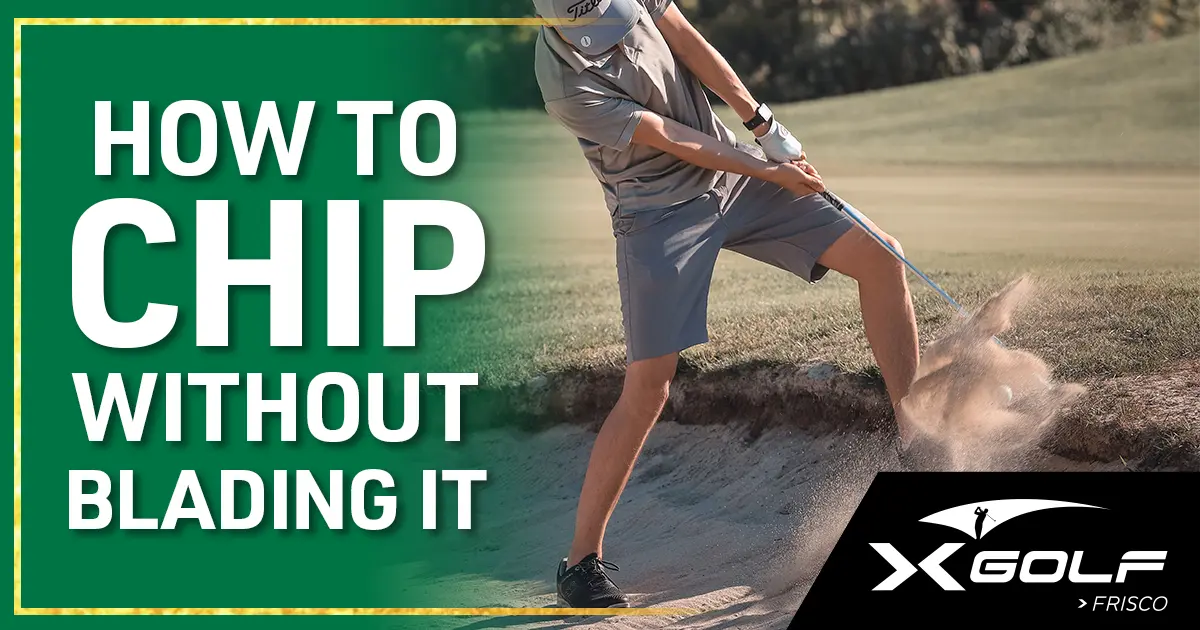
You blade chips because you are trying to help the ball into the air. Take that job away from your hands and the shot gets very hard to hit. Here is the setup, the stroke, and two drills.
What a bladed chip actually is
A blade is contact with the leading edge, the sharp bottom lip of the clubface. Instead of sliding under the ball, that edge catches the ball around its equator, so the ball comes off low and fast with almost no spin and does not stop until it finds the far collar.
Trillium Rose, a GOLF Top 100 Teacher, describes the same miss: the leading edge strikes near the equator and the ball screams across the green with very little spin.
Most advice on how to chip in golf starts with the stroke. Start with the fault instead, because the blade has one root cause: your brain decides it has to lift the ball, so your body tries to help.
That help shows up at impact in a few predictable ways:
- your weight hangs back on your trail foot, which tips the low point of the swing behind the ball
- the clubhead passes your hands before it reaches the ball, because your wrists flip
- the handle ends up behind the clubhead, adding loft you never needed
- the ball sits too far forward in your stance, which adds more loft again
- a long backswing makes you decelerate, and a decelerating club has no idea where the bottom of its arc is
Brendon Elliott, a PGA of America professional, puts the instinct bluntly. Golfers flip their hands under the ball because the brain expects them to make it airborne. Your wedge already carries more loft on the face than the shot needs, and your job is to deliver it.
Two neighbors of this fault have their own guides here. A chunk digs into the turf behind the ball, covered in how to stop chunking irons. A top catches the upper half of the ball on a full swing, covered in how to stop topping the ball in golf.
All three come from a low point in the wrong place, and the blade costs the most: a chunk stays on the green, while a bladed chip leaves you chipping again from the other side. Everything below is the short running chip you play from a few paces off the putting surface.
Step 1: Narrow your stance and pull your lead foot back
Set your feet closer together than shoulder width, then pull your lead foot back a couple of inches. James Sieckmann, a GOLF Top 100 Teacher who specializes in the short game, teaches a narrow stance with the feet inside the shoulders and the front foot open.
A narrow stance is not about power, which a chip barely needs. It stops you swaying off the ball, and sway is how your weight ends up on the back foot at impact.
Pulling the lead foot back opens your hips and leaves room for your chest to keep turning through the shot. It also lets you watch the landing spot without lifting your head, another quiet cause of thin contact.
Grip down the handle an inch or two and step closer so your hands hang under your shoulders. If you feel stretched out, you are too far away, and reaching pulls you off the ball on the way down.
Step 2: Get your weight onto your lead foot and keep it there
Lean into your lead foot until it holds about 60% of your weight, then keep it there for the whole swing. Sieckmann uses that same split, with the chest aimed a touch past the ball rather than at it. Coaches teach anywhere from 60 to 70 percent.
Weight forward moves the low point of your swing arc to a spot in front of the ball, which is the whole trick. The club arrives while it is still travelling down, catches the ball first, then brushes the grass.
The common failure is loading forward at address and drifting back on the way down, usually at the exact moment you decide to help the ball up. Your trail heel is the tell: if it lifts and your belt buckle slides away from the target, the blade is already on its way.
Keep your lead knee soft and stacked over your lead foot from start to finish.
Step 3: Push the handle forward toward your lead thigh
Your hands should sit far enough down the target line that the grip end of the club points at your lead thigh. Sieckmann puts a number on it: 6 to 8 degrees of forward shaft lean, which looks like almost nothing from behind.
Hands ahead of the clubhead lean the shaft at the target, which takes a little loft off the face and keeps the leading edge travelling down and forward instead of up and under.
Do not hood the face to get there. Twisting the clubface shut aims the leading edge at the ball’s equator, so move the handle and leave the face alone.
Check it with a phone camera from face-on. You want the shaft tilted gently at the target and the face still looking at the sky as much as it did at address.
Step 4: Turn your chest instead of flipping your wrists
Turn your chest through the ball and let your arms come along with it, closer to a putt with a longer club than to a swing.
Elliott’s fix for scooping is to keep the chest moving through impact, because a body that keeps rotating gives the hands nothing to do. When the body stops turning, your wrists take over.
Your wrists still hinge a little going back, which is unavoidable. What you remove is the active unhinging through impact, the scoop that throws the clubhead past your hands.
One feel that works: the back of your lead wrist stays flat and keeps pointing at the target through the strike. If it cups and your glove logo turns to the sky, you flipped it. Finish with your chest facing the target and the clubhead low.
Step 5: Shorten the backswing so you can accelerate
Cut your backswing roughly in half, then accelerate through the ball. Deceleration is what turns a small technical flaw into a disaster, and long backswings are what cause it.
You take the club too far back for a 20-yard shot, realize mid-swing that you are about to hit it 40, and slow down. The club bottoms out early, your hands quit, and the leading edge shows up at the ball’s equator.
Kellie Stenzel, another GOLF Top 100 Teacher, teaches equal speed back and through and warns that deceleration is what makes the club dig. Elliott asks for the same thing from the other side: a shorter backswing with continuous speed.
Distance comes from how far back you go rather than how hard you hit, so a short backswing with a confident strike is the only sensible way to play a short chip. Hold the finish for a two count, and if you cannot hold it, you were out of balance.
Step 6: Aim at a landing spot, not the flag
Pick a spot of green where you want the ball to touch down and aim at that instead of the hole. Jordan Dempsey, who teaches at the PGA Tour Performance Center in Ponte Vedra Beach, recommends a landing spot roughly halfway between your ball and the hole, then letting the ball roll from there. Move that spot nearer the flag with a lob wedge and nearer to you with an 8 or 9-iron.
Aiming at a flag 15 yards away makes you feel like you need height, and needing height is what makes you scoop. A landing spot 7 or 8 yards away gives you something you can reach with a small, low, accelerating stroke.
Pick a real mark rather than a general area, like a discolored patch or an old ball mark.
How to chip off a bare, tight lie without blading it
A bare, tight lie asks for less loft, not more help. There is almost no grass under the ball to cushion the club, so the wide sole of a lob wedge can skip off the firm ground and throw the leading edge at the ball’s equator.
The angle on the sole of a wedge is called bounce, and it exists to stop the club digging in soft turf. On hardpan and thin Bermuda that same angle works against you.
Drop down to an 8-iron or a pitching wedge instead of your most lofted wedge, keep the same 60% on your lead foot, and think about brushing the paint off the grass. North Texas fairways in August give you plenty of practice.
Why the blade comes back on the course
Blades come back on the course because the shot suddenly matters. A nervous golfer slows the club down and looks up early, and both of those put the low point back behind the ball.
Build a routine you can repeat when it counts. Pick the landing mark, take two rehearsal strokes at the speed you actually intend to swing, then keep your eyes on the grass until you hear the strike.
Two drills to practice how to chip in golf
Both drills take about ten minutes, and both are easier indoors where the lie is flat and nothing rolls away from you.
The lead-foot-only drill
Take your normal chipping stance, then pull your trail foot back and up onto its toe so all your weight sits on your lead foot. Rose teaches this one as the diagnosis and the cure at once.
Hit 15 short chips from there. You will feel how little room you have to fall back, and you will start catching the ball before the ground without trying. Then put the foot down and keep the feeling.
The tee-ahead drill
Push a tee into the ground two inches in front of your ball, on the target side, then hit the chip and try to clip the tee after the ball. That is Elliott’s low-point drill, and every swing gives you a pass or a fail.
Clip the tee and your low point is in front of the ball, which means the blade is gone. Miss the tee, or thump the ground before it, and your weight went backward.
Bring your wedge to X-Golf Frisco
Short shots are the hardest thing to practice at a normal range, because you never see where the ball lands and nobody builds you a green to aim at. The 10 bays at X-Golf Frisco solve both problems at once.
X-Golf’s system puts sensors above and below the ball, with four lasers and a high-speed camera overhead, so a chip that never gets near the screen still gets read. Single-camera setups mostly see shots that make it all the way there, which is why short-game work on them feels like guessing. Watch the launch angle on a bladed chip, then on a clean one, and you can see the difference on screen.
Then order something from the kitchen and see who wins the up-and-down count. Weekday mornings are the quiet window at X-Golf Frisco if you want a bay to yourself.
Book a bay at X-Golf Frisco when you are ready, add a coach through golf lessons at X-Golf Frisco if you want eyes on your weight shift, and find out whether the fix holds up with people watching at a Frisco league night. Living in the town that hosts the PGA of America headquarters does not make anyone’s chipping better, but it does raise the standard of the trash talk.
Frequently asked questions
How long does it take to stop blading chips?
Most golfers see cleaner contact inside a single 30-minute session, because weight forward and handle forward change the strike immediately. Making it stick takes longer. Treat it as grooved once you can hit 17 clean strikes out of 20 and the old scoop stops turning up on the first chip of the day.
Should I just putt from off the green instead?
Sometimes, yes. When the fringe is short and the ground is dry, a putter takes the leading edge out of the equation completely. Once the rough gets longer than about an inch, the putter face snags and the chip becomes the better play. Learn both and choose by the lie.
What should I practice once my chipping contact is clean?
Distance control. Set targets at 10, 20 and 30 yards, hit five balls to each, and change only your backswing length. Most golfers lose more strokes to a clean chip that finishes 20 feet short than to a thin one. A bay session with the numbers on screen exposes those gaps inside 20 minutes.