Nobody should pick a grip because a blog said strong is better. Your ball flight already knows the answer, and it takes about twenty shots in a bay to confirm it.
What strong grip vs weak grip golf actually means
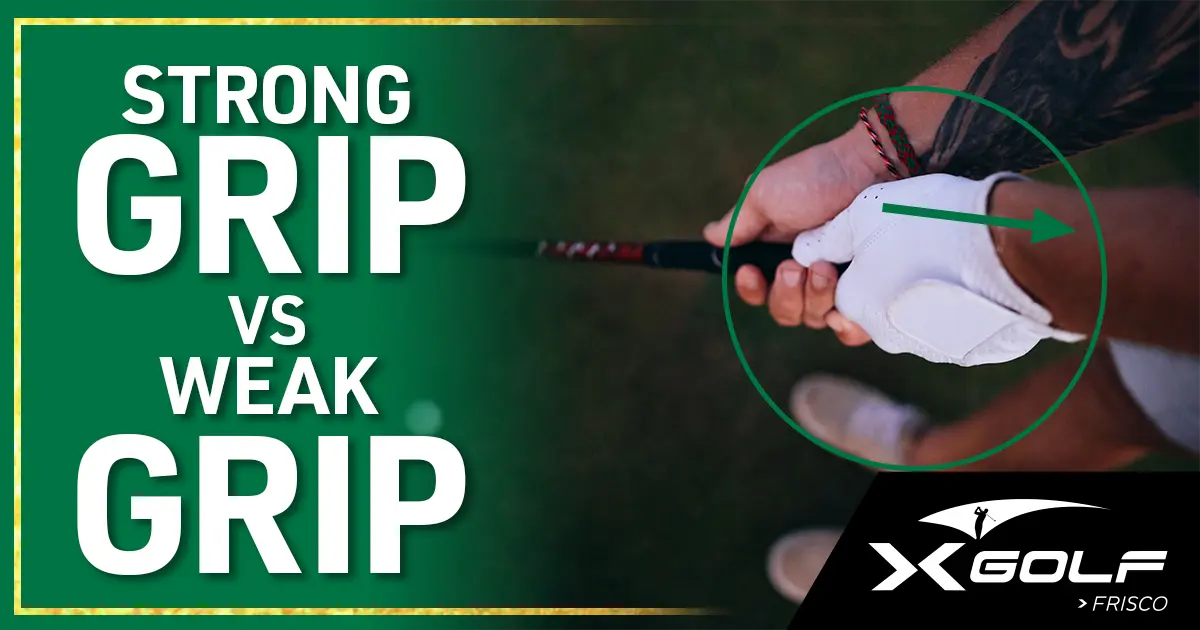
Strong grip vs weak grip golf refers to how far your hands are rotated on the handle, not how tightly you squeeze. A strong grip turns both hands away from the target and closes the clubface sooner. A weak grip turns them toward the target and leaves the face open longer.
Two things get mixed up with this constantly. The first is grip pressure. You can hold the club like you are strangling it and still have a weak hand position, because strength here describes rotation, not effort.
The second is the rubber on the club. Grip size and texture are an equipment question, and they matter, but they sit apart from where your hands go. If your hand placement itself feels unfamiliar, start with how to grip a golf club for consistency and control and come back here once neutral feels normal.
Start with the miss you already recognize
Picture your worst hole from last weekend. Most golfers have one miss that shows up over and over, and it is usually one of these two.
The first one starts on line or a touch left, then turns hard left and keeps going, into the trees or the next fairway or the cart path. You did not aim there, and it happened three times on the front nine.
The second one looks fine for about a second before it leaks right, lands right, and leaves you a long walk and a longer club. Sometimes it starts right and never comes back at all.
Both patterns come down mostly to where the clubface pointed at impact, and your grip sits upstream of that. We cover the swing side of each miss in how to stop slicing the golf ball and how to fix a hook in golf, so this post stays on the hands.
Why your grip decides how much work your hands have to do
Your grip sets how much your forearms have to rotate to get the clubface square by impact. It does not aim the face directly.
Rotate your hands away from the target and the face is already partly closed before you swing, so your hands have less to do on the way down. Square happens more or less on its own.
Rotate your hands toward the target and the opposite is true. The face sits more open, so your forearms have to turn harder and finish that turn at exactly the right moment.
It comes down to timing. A grip that needs precise timing works beautifully on the range and falls apart on the first tee with your buddies watching. One that needs less timing is more forgiving, though push it far enough and the miss just switches sides.
This is also why two golfers can take the same grip and get opposite results. If you already rotate your forearms hard through the ball, a strong grip stacks one closing move on top of another. If you barely rotate them at all, that same grip finally gets your face to square.
Read your own hand position with knuckles and the V’s
Take your normal hold, look straight down, and count the knuckles showing on the lead hand, which is whichever hand sits nearer the target. For a right-handed player that is the left. Then find the V shape that each thumb and forefinger makes and notice where it points.
| Hand position | Knuckles visible | Where both V’s point | What the face wants to do |
|---|---|---|---|
| Strong | Three or more | Outside your trail shoulder | Arrive closed, so your forearms rotate less |
| Neutral | About two | Between your chin and your trail shoulder | Nothing pre-set either way |
| Weak | One or none | At your chin or past it toward your lead shoulder | Stay open, so your hands do the squaring |
Count on a real club, not from memory. Golfers are wrong about their own knuckle count more often than they are wrong about their handicap.
Check that both hands agree, too. A lead hand rotated away from the target paired with a trail hand turned the opposite way is two grips fighting each other, and the face does whatever the stronger hand decides that day.
Strong: three or more knuckles showing
A strong golf grip shows three or more knuckles at address, which is your set-up position over the ball. The trail hand rolls under the handle, the V’s point outside your trail shoulder, and the face arrives closed unless your forearms hold it off.
If your bad shots turn hard left, a strong hold is usually part of the reason.
Neutral: about two knuckles showing
A neutral golf grip shows about two knuckles, with both V’s pointing somewhere between your chin and your trail shoulder. Nothing is pre-set for you and nothing works against you, which is why most instruction starts a new golfer here.
Treat neutral as the baseline. Every change you make afterwards gets measured from it.
Weak: one knuckle or none
A weak golf grip shows one knuckle or none, with the trail hand riding on top of the handle and the V’s pointing at your chin or past it toward your lead shoulder. The face wants to stay open, so your hands have to do the squaring on the way down.
If your bad shots leak right, a weak hold is usually part of the reason.
Playing left-handed flips the count
Play left-handed and your right hand becomes the lead hand, so that is the one you count knuckles on. A strong hold still turns both V’s toward your trail shoulder, which for you means the left one.
The rest of this page reads the same. Away from the target is stronger, toward the target is weaker, whichever way you swing.
The test-and-confirm loop that proves a grip change worked
Twenty shots settle it. Ten with your current hold, ten with your hands moved one knuckle, same club and same target both times. Use a mid iron, an 8 or a 7, and move one thing at a time.
- hit ten shots with your current hold and note where each one starts, not where it finishes
- write down which way each shot curved and how much
- rotate both hands one knuckle in the direction your miss calls for
- hit ten more with the same iron at the same target
- compare start direction and curve across the two sets, and ignore distance
Say your 8-iron starts a yard or two right of the flag and finishes twenty yards right of it, eight times out of ten. That is a face that is open at impact, and one knuckle stronger is a reasonable first move.
If the next ten start on line and finish within a few yards of it, you found something. If they now start left and dive, you went too far.
Nobody runs this loop outside because a range ball tells you almost nothing about curve, and three rounds of guessing is a slow way to learn. At X-Golf Frisco, every swing puts your start direction, your side spin and your club path back on the screen. Side spin is the sideways rotation that makes a ball curve, and club path is the direction the club was travelling through impact.
What each position costs you, including the over-correction trap
Neither position is correct on its own. Both have a trade-off, so pick based on your miss and how much timing you want to rely on.
A stronger position suits golfers who fight that right-side leak, and it tends to help players with slower swing speeds or anyone who never quite releases the club. It costs you shot variety, because holding off a fade with a strong grip means manipulating the face late, and that is the move that disappears under pressure.
A weaker position suits golfers who already turn the ball over too much, and players who want to work the ball both ways and control trajectory. It costs you forgiveness. Your hands have to rotate faster and finish on time every time, and if you already slice it, a weaker grip makes that worse.
The over-correction is the common failure. A slicer strengthens the grip, likes the first few shots, keeps going, and turns a slice into a hook by the third session.
Now the miss is on the other side, and the golfer blames the grip when the problem was how far they moved it.
The short game carries its own cost. A closed face works against you on a delicate pitch, because loft, the angle sitting on the face, is what makes the ball climb and stop. Plenty of strong-grip players neutralize their hands slightly for anything inside forty yards and keep the strong position for full swings.
Does a strong grip add distance?
A strong grip does not add distance by itself. What it can do is stop you losing distance, because a face that arrives square delivers more of your speed into the back of the ball than a face that arrives open and cuts across it.
That is why golfers often report longer shots after strengthening their grip. They did not swing any faster, they stopped leaking energy sideways. Distance is also the worst number to judge a grip change by, since it moves for a dozen reasons at once, so compare start direction and curve instead.
Which grip should a beginner start with?
Start neutral, about two knuckles showing. A new golfer has no established miss to correct yet, so a neutral hold gives you a baseline you can move away from once a pattern actually appears.
Give it a few sessions before you change anything. Most beginners have a hold that drifts from swing to swing, and a drifting grip produces a scattered miss that looks like a clubface problem when it is really a hands problem.
Give a grip change a week or two before you judge it
A new grip feels wrong. Not slightly wrong, actively uncomfortable, like someone handed you a club that belongs to a stranger. That feeling is not a signal that the change is bad.
Your hands have found the same spot on the handle thousands of times, and they will keep trying to go back there. Short frequent sessions retrain that faster than one long grind, so three half hours beats one marathon.
Judge the change on the pattern in your notes, not on how it feels.
Confirm your grip at X-Golf Frisco
Book a bay, bring one iron and this article, and run the twenty-shot loop while the kitchen and bar handle everything else. X-Golf reports 98% shot prediction accuracy from its multi-sensor system, and every shot puts your start direction and curve on the screen before you tee the next one.
Bring a friend and make it interesting. Six people fit in an X-Golf Frisco bay, and half of them are fighting the same miss you are. To find out whether the change holds up with a card in your hand, our Frisco league nights will tell you fast.
Book a bay at X-Golf Frisco and stop guessing about your hands.
Frequently asked questions
Should I use the same grip position for every club?
Keep the same position through your irons and woods so your release feels consistent. Putting is the exception, since the stroke uses almost no hand rotation and most putter grips are built to limit it. Some players also neutralize slightly on short wedge shots to keep the face open for loft. Test any change one club at a time.