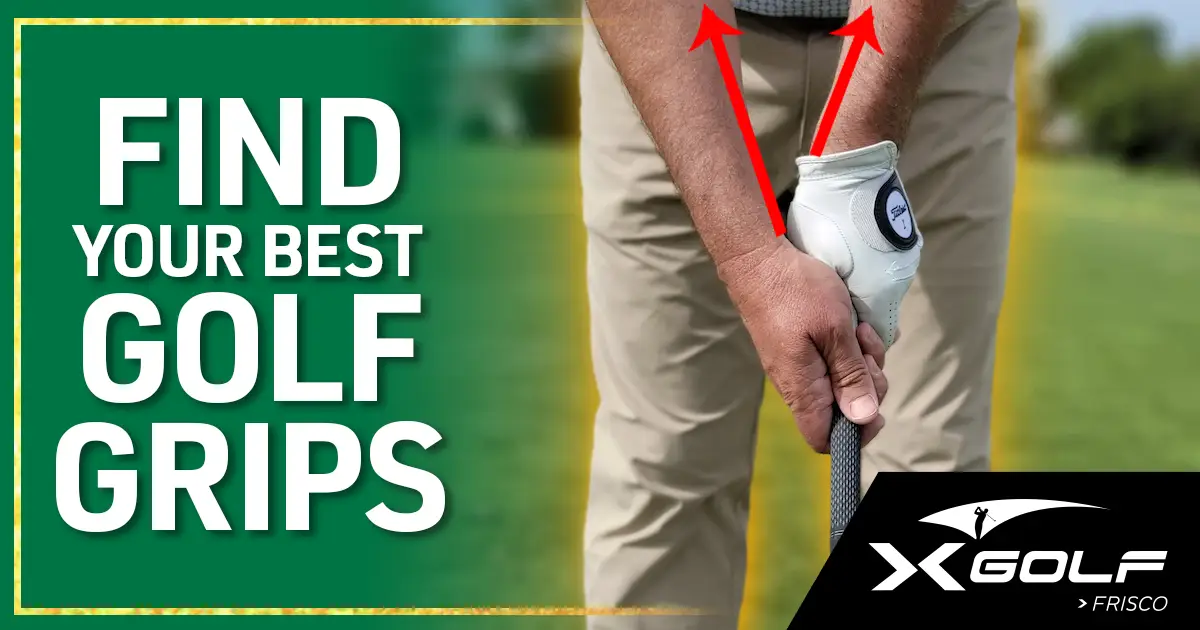
Most golfers get fitted for clubs but never think about the grip wrapped around them. Four quick checks tell you whether yours is helping your swing or fighting it.
Why your grip choice matters more than you think
Your golf club grips control how the club sits in your fingers. That affects wrist action, face angle at impact, and where the ball ends up.
A grip that’s too small lets your hands get overactive. You’ll tend to flip the club through impact, which leads to hooks and inconsistent contact. A grip that’s too large does the opposite: it locks up your wrist release, pushes shots right, and costs you distance.
Here’s what most golfers miss. You might have been fitted for the right shaft flex and club head, but the grip is where your body actually connects to the club. If that connection doesn’t match your hands, the rest of the fitting is working against itself.
How to measure your hand for the right grip size
Grab a tape measure or ruler. Place it at the crease of your lead wrist (the hand closest to the target when you address the ball) and measure straight down to the tip of your middle finger. That number is your starting point for golf club grip fitting.
Golf club grip size chart:
| Hand measurement | Grip size |
|---|---|
| Under 6.5 inches | Undersize |
| 6.6 to 7.5 inches | Standard |
| 7.6 to 9 inches | Midsize |
| Over 9 inches | Jumbo / Oversized |
Your glove size works as a quick cross-reference. Small and medium gloves typically align with standard grips. Large and XL gloves point toward midsize. But glove sizing varies between brands, so the tape measure is more reliable.
Once you have your measurement, do the finger test. Grip the club with your normal hold and check where your fingertips land. They should lightly touch the heel pad of your palm. If your fingers dig into the pad, the grip is too small. If there’s a visible gap between fingertips and palm, it’s too large.
If you’re still building your grip fundamentals, start with how to grip a golf club before adjusting size.
What your grip pressure tells you about grip fit
Hand size gives you a starting point. Grip pressure fills in the rest.
Think of pressure on a 1 to 10 scale, where 1 is barely holding the club and 10 is a white-knuckle squeeze. Most golfers play their best somewhere between 4 and 6.
If you’re squeezing hard just to keep the club from twisting, the grip might be too small or too smooth for your hands. If the club feels like it’s slipping even with light pressure, the grip could be too firm or too large for your fingers to wrap around properly.
Texture matters here. Rubber grips feel soft and absorb vibration. Corded grips are firmer and give you more traction, especially when your hands are sweating. Hybrid grips split the difference, with cord on the upper hand and rubber on the lower. Wrap-style grips feel smooth and slightly cushioned, similar to a tennis racket handle.
Your pressure habits connect to your swing tendencies too. Golfers who grip tight through impact often benefit from a slightly larger, softer grip that reduces the urge to squeeze. If you tend toward a lighter hold, a textured grip adds control without forcing you to clamp down. Understanding different types of golf swings helps you see how grip pressure fits into the bigger picture.
Matching your grip to how you play
Beginners and casual players
If you’re newer to the game, start with a softer, standard-size rubber grip. These reduce vibration on off-center hits (which happen often when you’re learning) and they’re forgiving enough that small grip changes won’t throw off your whole swing.
If you notice hand tension after a round, or if you’re fighting the club to keep it square, try moving up to a midsize grip. The extra diameter can quiet your hands and make the club feel more stable.
For more on getting started, check out golf tips for beginners and beginner swing drills.
Seniors and golfers with joint pain
Midsize or oversized golf club grips reduce the force your fingers need to apply. That’s a direct benefit for anyone dealing with arthritis or joint stiffness.
Softer rubber compounds absorb more vibration at impact, which means less shock traveling into your hands and wrists. Lighter grip weight helps too: a lighter grip lets you maintain swing speed without adding effort. If you’ve been playing with standard grips for years and your hands are telling you to change, listen.
Golfers who play in heat or humidity
Texas summers test your grip. Sweat and humidity make rubber grips slick, which forces you to squeeze harder and burns energy over 18 holes.
Corded grips handle moisture better than pure rubber. The rough texture channels sweat away from the contact area. Hybrid grips (cord on top, rubber on the bottom) give you moisture control where your lead hand needs it most without sacrificing comfort on the lower hand.
Grip tape wraps can fine-tune the diameter while adding traction. Some golfers add 1 or 2 extra wraps under the grip to build up the size slightly without switching to a completely different model.
When to replace your grips (and what you need)
Grips wear out faster than most golfers realize. After 40 to 60 rounds (or roughly once a year if you play regularly), the rubber loses its original texture and traction.
Check for these signs:
- shiny or glossy patches where your fingers sit
- rubber that feels hard or slick compared to a new grip
- smooth spots where the texture pattern has worn flat
- the grip twisting or sliding on the shaft during your swing
A golf club grip replacement kit covers a full set for under $20 in supplies. You’ll need grip solvent, double-sided grip tape, a vise clamp to hold the shaft, and a utility blade to remove the old grip.
Regripping at home takes about 5 to 10 minutes per club once you’ve done a few. If you’d rather skip the mess and drying time, most pro shops and golf retailers will regrip a set for $3 to $5 per club plus the cost of the grips.
Test your grip fit at X-Golf Frisco
A size chart gets you close, but the real test is swinging a club and watching what happens.
At X-Golf Frisco, the simulator bays track ball flight and spin data on every shot. You can swap grips between rounds and see exactly how the change shows up in your numbers instead of waiting for a range session to confirm a hunch.
If you want feedback from an instructor while you’re testing, golf lessons at X-Golf Frisco pair swing coaching with real-time simulator data.
Book a bay at X-Golf Frisco and bring your clubs, or join a Frisco league night where you can compare notes with other players while you play.