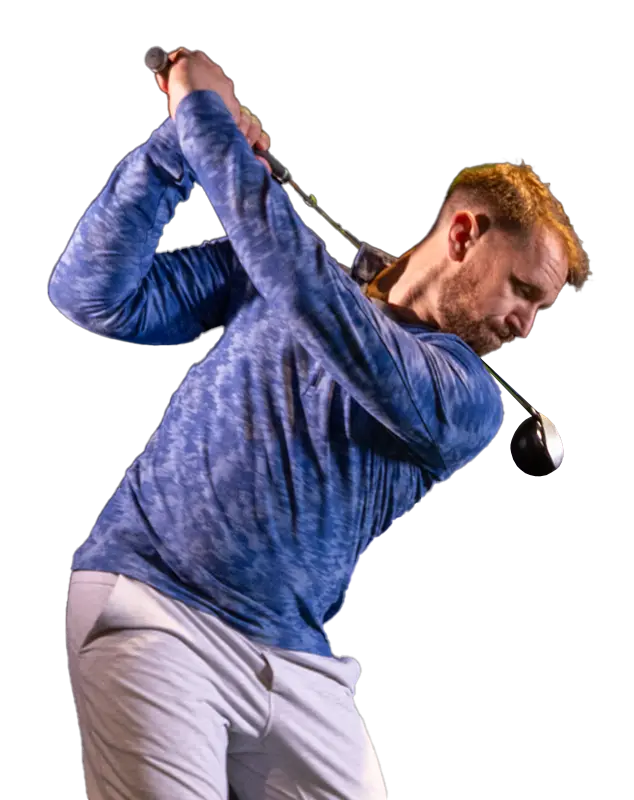
Every curved shot has a specific cause. X-Golf Frisco’s simulator records it on every swing. Most golfers just don’t stay on screen long enough to find it.
Every curve starts with sidespin
A golf ball in the air is always spinning. Most of that spin makes it climb and carry, but some of it leans sideways, and that sideways lean is sidespin. Lean right and the ball curves right; lean left and it curves left. A shot with almost no sidespin flies close to straight. That almost never happens.
Impact is where the curve gets created
The gap between where your clubface is pointing and where your club is traveling at the moment of contact is what puts that sideways lean on the ball. A face open to your swing path sends the ball curving right; a face closed to your path sends it left. A bigger gap means more curve.
It all happens in a fraction of a second. Watching the ball flight afterward doesn’t tell you which of those two variables caused the problem. The sidespin number does.
The physics are worth knowing once
As the ball moves through the air, one side pushes into the airflow while the other runs away from it. That pressure difference shoves the ball sideways, the same way a pitcher’s curveball or a bending free kick works. The ball isn’t drifting. It’s getting pushed, and the direction was set at impact.
Backspin vs. sidespin: what each one tells you
Backspin is what makes the ball climb and carry, measured in RPM. Sidespin is the part that curves it left or right, and that’s the number that decides which direction the ball bends.
The simulator tags sidespin “+” for right and “-” for left. More sidespin to the right means more fade, and enough of it becomes a slice. More to the left means more draw, and enough of it becomes a hook.
Where the problem usually lives
Sidespin that’s consistently strong to the right usually traces back to grip position or releasing the club too late on the way through. Consistently strong to the left is usually the hands getting too active in the downswing.
Your club path, meaning which way the club was moving at impact, is the other half of the picture. Read alongside sidespin, it tells you which side the gap falls on. Without it, you’re trying to correct something you only saw as a ball flight.
The simulator shows you cause and result on the same screen
At X-Golf Frisco, club path and sidespin display together after every shot. Book a bay if you’ve never watched your numbers shot by shot. On a real course, you’re reconstructing the cause from a result that wind and slope have already muddied.
Use sidespin as a progress tracker, not just a score
Hit 10 shots with a mid-iron and note your average sidespin. That’s your starting number. Watch whether it moves as you make adjustments, and track it across sessions to know whether a change is real rather than just one good swing.
Doing this alongside a golf lesson at X-Golf Frisco means someone is interpreting the numbers with you. Individual shots jump around. The trend across a session is what counts.
Come see your numbers at X-Golf Frisco
Your sidespin has probably been leaning the same direction for a long time. The simulator makes it visible for the first time. Our Frisco golf leagues keep you in the bay on a regular schedule, which is really the only way those numbers start to shift.