Here’s a stat that might surprise you: 50% of beginner golfers quit within two years.
Not because they don’t love the game. Because the learning curve feels impossible. The driving range is intimidating. The course rules are confusing. And after a few embarrassing rounds, walking away seems easier than pushing through.
Indoor golf lessons change that equation entirely.
If you’re new to golf and wondering where to start, this guide covers the specific benefits indoor lessons offer beginners—and why starting indoors might be the smartest decision you make for your golf game. For foundational advice, check out our golf tips for beginners.
Why Beginning Golfers Struggle Outdoors
Let’s be honest about what makes learning golf so hard.
The range is intimidating. You’re surrounded by experienced golfers striping shots down the middle while you’re topping balls into the grass 30 feet in front of you. Everyone can see. Everyone can hear. That self-consciousness makes it nearly impossible to relax and learn.
You don’t know what you don’t know. Without feedback, you can’t tell if that decent shot came from good mechanics or lucky timing. You practice the same mistakes over and over, ingraining bad habits that become harder to fix later.
Weather disrupts consistency. You finally start building momentum, then a week of rain kills your practice routine. By the time you get back out, you’ve forgotten half of what you learned.
Course pressure adds stress. Worrying about pace of play, etiquette, and the group behind you makes it impossible to focus on your swing. You rush shots just to get out of the way.
Indoor lessons solve every single one of these problems.
Learn Without Anyone Watching
This benefit alone keeps more beginners in the game than any technology ever could.
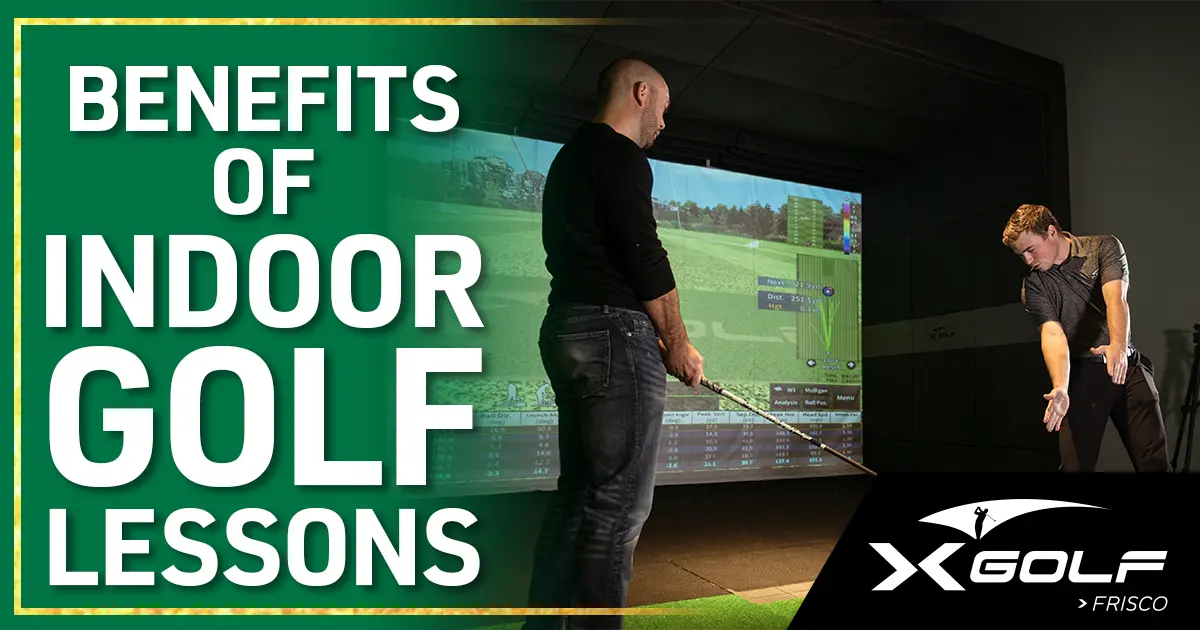
Indoor golf facilities offer private or semi-private bays where you can swing freely without an audience. No experienced golfers judging your technique. No pressure to hurry. Just you, your instructor, and the feedback you need to improve.
For many beginners, this privacy is everything.
You can whiff completely and nobody notices. You can ask “basic” questions without feeling stupid. You can experiment with your swing without worrying about holding up a line of impatient golfers waiting for the bay.
That relaxed environment accelerates learning. When you’re not stressed about being watched, your body moves more naturally. Your instructor’s advice actually sinks in. Progress happens faster.
Understand Your Swing From Day One
Here’s the problem with learning golf outdoors: you get zero useful feedback.
You hit a ball. It goes somewhere. Maybe it went where you wanted, maybe it didn’t. But you have no idea why. Was your clubface open? Did you swing too steeply? Did you decelerate through impact?
Without answers, you’re just guessing.
Indoor simulators eliminate the guesswork.
Modern technology tracks exactly what happens at impact. You see your club path, face angle, ball speed, launch angle, and spin rates—all the metrics that determine where your ball goes and why.
More importantly, your instructor sees them too.
When your lesson includes real data, corrections become specific and actionable. Instead of vague advice like “try to release the club more,” you get concrete guidance: “Your face is 4 degrees open at impact—let’s work on your grip to square that up.”
Beginners who learn with data understand their swings faster. They know exactly what to practice between lessons. They build correct fundamentals from the start instead of spending years trying to unlearn bad habits.
Build Fundamentals Before Adding Variables
Golf is hard enough without fighting the elements.
When you’re learning outdoors, you’re simultaneously trying to master grip, stance, posture, takeaway, backswing, transition, downswing, impact, and follow-through—while also adjusting for wind, uneven lies, and temperature changes.
That’s too many variables for a beginner brain to process.
Indoor lessons let you isolate the fundamentals.
The environment stays constant. The mat is flat. There’s no wind pushing your ball offline. Every variable is controlled except the one that matters: your swing mechanics.
This controlled setting is ideal for building muscle memory. You can repeat the same motion hundreds of times in consistent conditions, ingraining the correct movement patterns before you ever have to adjust for real-world factors.
Once those fundamentals are solid, transitioning to outdoor golf becomes much easier. You’re not learning everything at once—you’re adding course variables to a swing that already works.
See Your Swing in Slow Motion
Video feedback transforms how beginners learn.
Most indoor facilities record your swing with high-speed cameras and play it back immediately. You can watch your takeaway, see your position at the top, and analyze your impact position frame by frame.
This visual feedback creates breakthrough moments.
You might feel like you’re keeping your head still, but video shows you’re lifting up two inches before impact. You might feel like you’re finishing in balance, but video shows you’re falling backward.
Those gaps between feel and real are where improvement lives.
Your instructor can draw lines on the video, compare your swing to professional models, and show you exactly what needs to change. You leave each lesson with visual proof of what you’re working on—not just verbal instructions you’ll forget by tomorrow. Learn more about tracking your golf stats with simulator technology.
Practice Year-Round Without Excuses
Consistency matters more than intensity when you’re learning golf.
One lesson every two weeks beats three lessons crammed into a month followed by nothing for six weeks. Your brain and body need regular repetition to develop new movement patterns.
Indoor facilities make consistency possible.
Texas summers hit 100 degrees. Winter gets too cold for comfortable practice. And while some DFW courses close seasonally, indoor golf doesn’t care about weather. The climate stays comfortable year-round.
You can take lessons after work when it’s dark outside. You can practice in August without risking heat exhaustion.
This year-round access means you never lose momentum. You don’t spend three months forgetting everything you learned, then start over in spring. Your improvement compounds continuously instead of resetting every season.
Skip the Course Pressure (For Now)
Here’s permission you didn’t know you needed: you don’t have to play on a real course yet.
Many beginners feel pressured to get out on the course before they’re ready. They book a round, spend four hours feeling embarrassed and stressed, and walk away convinced they’re “not cut out for golf.”
That’s not a failure of ability. That’s a failure of timing.
Indoor lessons let you build genuine competence before facing course pressure. You develop a reliable swing in a low-stress environment. You learn to hit different clubs with reasonable consistency. You build confidence through actual skill development—not just hope.
When you finally do step onto a real course, you’ll have the foundation to handle it. You won’t be learning the basics while also navigating cart paths, bunkers, and pace-of-play anxiety. You’ll just be applying skills you already own.
Learn Course Strategy Without the Stakes
Advanced indoor simulators recreate famous golf courses with stunning accuracy. Curious about the technology? See what simulator X-Golf uses.
This means you can play Pebble Beach, St. Andrews, or dozens of other world-class courses without ever leaving Frisco. More importantly, you can learn course management without the pressure of a real round.
For beginners, this is invaluable.
You learn when to hit driver versus when to lay back. You practice approach shots to realistic greens. You start understanding how course design influences strategy—all without holding up a foursome behind you.
When your instructor plays a simulated round with you, they can pause after any shot and explain the decision-making process. Why did we aim there? What were the risks? What would happen if the wind was different?
This strategic education usually takes years to develop on real courses. Indoor simulation compresses that timeline dramatically.
Get Personalized Attention
Group lessons at driving ranges often mean one instructor splitting attention among eight or ten students.
You get a few minutes of feedback, then you’re on your own while the instructor helps someone else. Questions pile up. Confusion compounds. You leave without the clarity you came for.
Indoor lessons are typically one-on-one or small group.
Your instructor focuses entirely on your swing, your questions, and your development. Every minute of your lesson delivers value. You get immediate answers instead of waiting your turn.
For beginners especially, this personalized attention matters. Your questions aren’t “basic”—they’re foundational. You deserve clear answers from someone who understands your specific challenges and goals.
Build Confidence Before Going Public
Let’s talk about what really happens when beginners get indoor lessons.
You develop actual skills in a supportive environment. You understand your swing through data and video. You see measurable improvement session after session. You build genuine confidence based on competence—not wishful thinking.
That confidence changes everything.
When you finally join friends for a round, you’re not terrified of embarrassing yourself. You know you can make contact. You know your ball will generally go forward. You’re ready to enjoy the experience instead of white-knuckling through it.
This is how beginners become lifelong golfers instead of two-year dropouts. They start in an environment designed for learning, build real skills, and transition to outdoor golf from a position of strength.
What to Look for in Beginner-Friendly Indoor Lessons
Not all facilities are equally welcoming to new golfers. Here’s what matters:
Patient, certified instructors. Look for PGA professionals who genuinely enjoy teaching beginners. Their job is to make golf accessible, not to show off their knowledge.
Modern technology. Video analysis and launch monitor data accelerate learning dramatically. Make sure the facility invests in quality equipment.
Comfortable environment. The vibe should feel welcoming, not intimidating. If you walk in and feel out of place, trust that instinct.
Flexible scheduling. You need consistency to improve. Find a facility with lesson times that fit your actual life.
Clear progression path. Good instructors help you understand what you’re working toward. They break complex skills into manageable steps and celebrate progress along the way. For practice between sessions, try these golf swing drills for beginners.
Start Your Golf Journey the Right Way
Golf doesn’t have to be frustrating, intimidating, or embarrassing.
Indoor lessons give beginners exactly what they need: private space to learn, instant feedback to understand their swing, consistent conditions to build fundamentals, and patient instruction to guide the process.
You can absolutely teach yourself golf through YouTube and range sessions. But most people who try that route either quit in frustration or spend years fighting bad habits they could have avoided.
Starting indoors is the shortcut that actually works.
Ready to Start?
X-Golf Frisco welcomes beginners with open arms. Our PGA-certified instructors specialize in making golf accessible, using advanced simulator technology and video analysis to help new golfers build confidence and skill.
You don’t need to know anything about golf to book your first lesson. You don’t even need your own clubs. Not sure what to wear? We’ve got you covered there too.
What you need is a willingness to learn—and we’ll handle the rest.
Book a beginner lesson at X-Golf Frisco and discover why indoor golf is the best place to start your journey.