The hook is the better player’s miss. Slices happen because the clubface is wide open and the swing is cutting across the ball. Hooks happen because you’re actually releasing the club. You’ve got speed, you’ve got face control, and somewhere along the way, both of those things started working a little too aggressively.
The frustrating part is that a hook feels close to a good shot. The contact is solid. The ball jumps off the face. Then it takes a hard left turn into trouble and you’re left wondering what happened, because you didn’t feel anything different.
That’s the real problem with a hook. The cause is hard to feel. So let’s talk about how to find it.
The hook isn’t one problem
A lot of golf content treats the hook like a single fault with a single fix. Weaken your grip, problem solved. But most golfers who hook consistently have something more specific going on, and the grip adjustment alone won’t fix it.
A hook happens when the clubface is closed relative to your swing path at impact. For a right-handed golfer, the ball starts somewhere right of target and curves hard left, usually low, with a lot of run. The question is why the face is closed, because three different things can cause it and each one needs a different correction:
- your grip is too strong, rotating the face closed before you even start swinging
- your body stops rotating through the shot, leaving your hands to take over and snap the face shut
- your swing path is too far inside-out, which magnifies the effect of even a slightly closed face
Some golfers have one of these. Plenty have two at the same time. And the tricky part is that fixing the wrong one can make the other worse. Weaken your grip when the real issue is rotation, and now you’re pushing everything right instead of hooking it left.
How to figure out which one is yours
This is where most golfers get stuck. On a driving range, you can see the ball hook, but you can’t see the data behind it. You don’t know if the face was two degrees closed or eight. You don’t know if your path was three degrees inside-out or six. So you start making changes based on feel, and feel is unreliable when you’re troubleshooting.
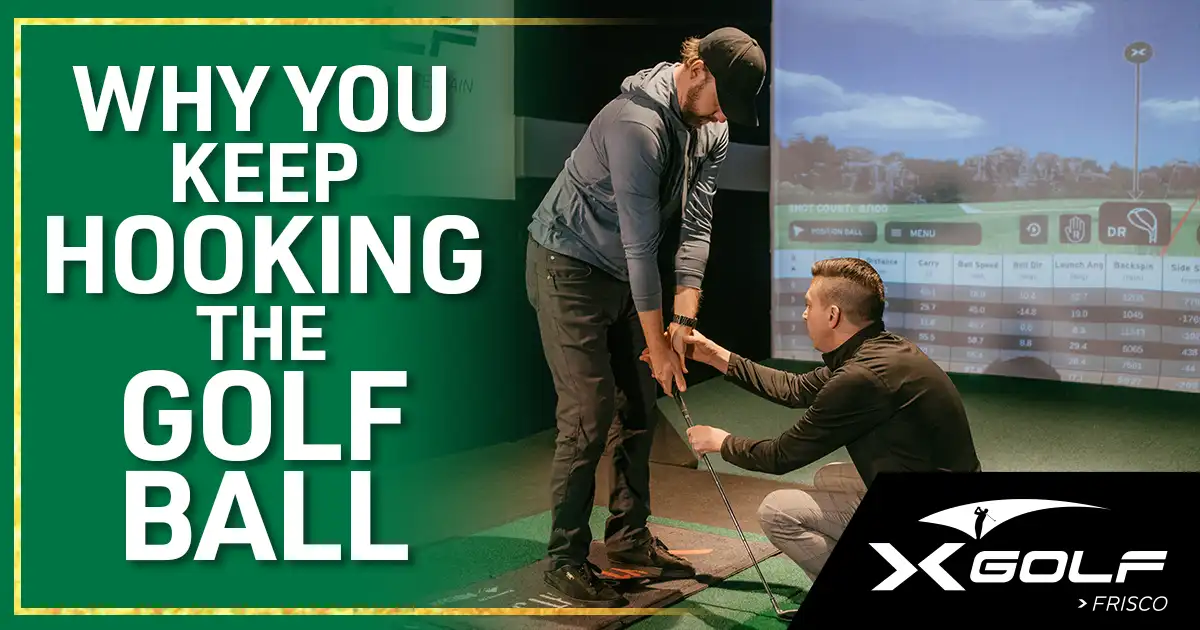
At X-Golf Frisco, the simulator gives you the numbers on every shot. Sidespin. Swing path in degrees. Ball spin direction. You can hit 10 shots without changing anything and see exactly what your pattern looks like before you try to fix it. That diagnostic step is something most golfers skip entirely, and it’s the reason so many hook fixes don’t stick.
Here’s a simple way to read the data once you have it:
- if your sidespin is strong toward the hook side but your path is relatively neutral, the grip is probably your primary issue
- if your sidespin is only mild but your path is well inside-out, the path is the bigger problem
- if the numbers bounce around from shot to shot with no consistent pattern, your body rotation is likely stalling and your hands are compensating differently each time
If it’s the grip
If the data points to your grip, this is the easiest of the three to correct. Hold the club at address and look down at your lead hand (left hand for right-handed golfers). You want to see two to three knuckles. If you see four, your hands are rotated too far to the right and the face is pre-loaded to close.
Rotate both hands slightly left on the grip until the V shapes formed by your thumbs and forefingers point between your chin and your right shoulder. That’s the neutral zone. Past your right shoulder is too strong.
The hard part isn’t making this change. It’s keeping it. A grip adjustment feels weird for the first couple of weeks, and most golfers drift back to their old position without realizing it. Check your knuckle count before every session, even after it starts feeling normal.
When your body stops turning
This one is harder to self-diagnose because it’s a sequencing issue. Your lower body starts the downswing, but at some point your hips and torso stop rotating and your arms have to finish the job. When the hands take over the release, the face closes fast.
Golfers who hook because of rotation often describe the feeling as “getting stuck.” The club feels trapped behind them, and the only way to save the shot is to flip the hands through. The ball goes left, but the root cause was actually in the hips.
A good drill for this is to hit half-speed shots where you focus entirely on finishing with your chest facing the target. Forget about distance. Forget about ball flight for the first 10 reps. Just feel what it’s like when your body keeps turning all the way through instead of stalling out.
An instructor can spot this pattern in about three swings. If you’re working through it on your own, film yourself from the face-on angle and watch whether your belt buckle is pointing at the target in your finish position. If it’s still angled to the right, your rotation is incomplete.
Our indoor golf lessons at X-Golf Frisco are built around this kind of diagnosis. The instructor watches your swing and reads the simulator data at the same time, so they’re not guessing either. They can tell you exactly where the rotation stalls and give you a drill that targets that specific point in the sequence.
The inside-out path problem
When your swing path is too far inside-out, you’re essentially swinging to the right of your target. If the face is square to the target but your path points right, the ball starts right and then curves left. If the face is even slightly closed on top of that, you get a hook that starts right and dives hard left.
The inside-out path often comes from an overcorrection. Golfers who used to slice learn to swing more from the inside, which fixes the slice, but they overshoot and end up with a path that’s too far right. It’s a common progression, especially for players who improved quickly.
To straighten the path, you need feedback on the actual numbers. At X-Golf Frisco, the simulator reads your path in degrees on every swing. You can set up a simple drill where you hit 10 shots with your normal swing, note the average path number, and then make small adjustments until you’re closer to zero.
One feel that works for a lot of players: try to finish with your hands more out in front of you rather than wrapping around your body. A shorter, more forward finish encourages a straighter path through the hitting zone. It won’t feel natural at first, but check the path data after a few reps and see if the numbers are moving.
Why the “why” matters more than the fix
There’s a reason this article started with diagnosis instead of drills. The internet is full of hook fixes, and most of them work for some percentage of golfers. But if you’re applying a grip fix to a rotation problem, you’re adding a new issue on top of the existing one.
Getting the data first tells you which part of the swing to work on. It also tells you when the fix is working, which matters more than you’d think. Feel can trick you. You might feel like you’ve made a huge change when the numbers show a one-degree difference. Or you might feel like nothing changed when the data shows your sidespin dropping session over session. The numbers keep you honest.
If you want to work through this with someone who’s done it before, an instructor at X-Golf Frisco has access to every data point the simulator tracks. They’ll figure out the cause in your first session and build a plan around it. A lot faster than troubleshooting on your own.
Hooks during league play
One more thing worth mentioning. If your hook shows up mostly during league nights or competitive rounds but not during casual practice, tempo might be the actual culprit. Pressure speeds up your transition, your arms fire before your body catches up, and the face closes.
If that sounds familiar, spend five minutes before your next league round hitting slow-motion half swings. Not to warm up the muscles. To slow down the transition pattern so your body remembers to lead. It’s a small thing that can keep the hook from showing up when it counts.
Get it diagnosed
A hook is fixable once you know what’s causing it. The fastest way to find out is to see the numbers, and the fastest way to do that is to book a bay at X-Golf Frisco and hit some shots with the data in front of you.
If you’d rather skip the self-diagnosis and go straight to an instructor, call (214) 308-9011 to check lesson availability.